The First Iron Works
The Massachusetts Bay Colony was settled in 1628 and from that time on the colony grew. By 1643 there were more than twenty towns and over 15,000 people in the colony. The settlers brought iron goods and tools with them, such as axes, nails, saws, kettles, and pots. If they needed new items they had to be ordered from England at high cost. One of the settlers' greatest needs was for iron. The colony needed a place to manufacture its own iron. Eastern Massachusetts had all of the materials needed for iron making -- water for transportation and power, wood for charcoal, iron ore and a flux.
In 1646 at Saugus, Massachusetts, an iron works was built to meet the demands for iron. The iron works mainly produced wrought iron bars - merchant bars, flats, and nail rod - which were used in making tools and as building materials. Some cast iron products such as pots, firebacks, skillets and kettles were also made. The settlement where the ironworkers lived was called Hammersmith. At Hammersmith, there were houses for the ironworkers, a farm, and other buildings.
Although the iron works produced good iron, the iron works was out of business by 1670. There were many reasons why it failed, such as management problems. The iron works was very expensive to run, they had to go farther away to get natural resources, and there was competition. Gradually, the iron works fell into ruin where it was covered by layers of earth and leaves. The only reminders of the iron works were the slag pile and the Iron Works House, which may have been the home of the agent of the iron works. So how is it that today we know much about the iron works and can visit the site and see the reconstructed buildings?
Court records and the writings of people have been studied. However, much of the iron works history was not written down. Many of the ironworkers and their families could not read or write and there were no sketches, drawings, or detailed descriptions of the iron works. Think about what was left behind and laid buried for over three hundred years. The history of Saugus Iron Works can be told through its artifacts; objects that are made or used by humans. Archaeology is the study of people and past cultures through the artifacts they leave behind. Archaeology helped us to learn information about the iron works and the people of Hammersmith that never would have been found in written records.
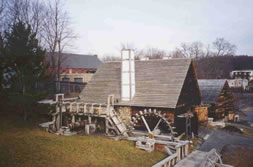
Starting in 1948, the iron works was excavated by archaeologist, Roland Wells Robbins, and a team of workers. A historian was hired to find and study any written documents about the iron works. Using the archaeological evidence and the historical documents a reconstruction was built. We now know more about the beginnings of life, work, and industry in America.
The Saugus Iron Works National Historic Site is important because it celebrates America's first successful iron works which helped the settlers to live in the New World. More importantly, the iron works helped to build an American iron and steel industry.